⚽ Dynamics-Induced Commitment in
Learning-Based Robotic Penalty Kicks

Submitted to IEEE TNNLS (Full version) and ICRA (Conf version)

* Equal contribution    ■ Corresponding authors

Humanoid (Unitree G1) shooter vs. quadruped (Unitree Go2) goalkeeper under zero-sum self-play.

Abstract

Learning in robotic games is constrained not only by strategic information but also by what the body can still execute. We study this coupling in a hierarchical humanoid–quadruped penalty system in which game-level self-play policies command fixed soccer whole-body controllers (S-WBCs). The humanoid shooting skill is initialized from self-collected motion-capture data, whereas the quadruped saving skill is learned by reinforcement learning. We introduce dynamics-induced commitment mapping (DIC-Map), a body-grounded analysis that estimates continuation capability, identifies the first persistent loss of a terminal alternative, and tests whether the remaining interaction admits a reduced zero-sum game. For symmetric terminal alternatives, the reduced game yields a closed-form bound on optimal strategy concentration determined by the responder's value of deferring. We further show that, when the responder acts through an estimator, equal response values eliminate the direct terminal-allocation gradient and leave an estimator-mediated first-order learning channel. Experiments locate commitment about 0.29 s before contact, and changing only ball speed shifts deferral coverage. Across four responder policies, replacing the estimator raises save rate from 0.240 to 0.472, whereas a comparable gain in read accuracy obtained by waiting raises it only to 0.246. Posterior analysis is used for the equilibrium comparison because the available coverage terms are observational proxies.
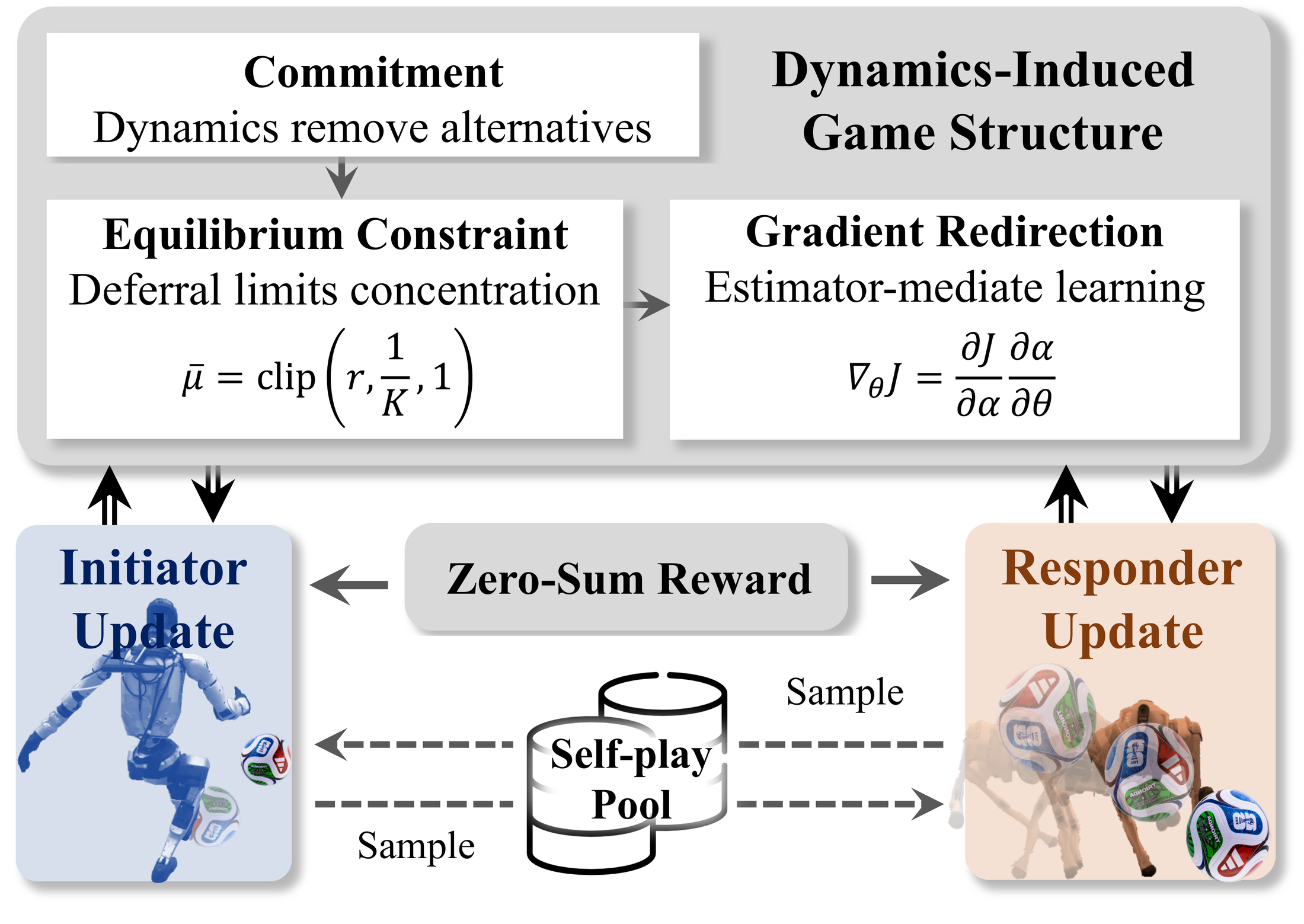
Game-learning framework overview
Figure 1: Overview of the proposed game-learning framework. Physical dynamics induce commitment, the responder's deferral option bounds equilibrium concentration, and estimator response values determine the active first-order learning channel during zero-sum self-play.

Three-Layer Architecture & DIC-Map

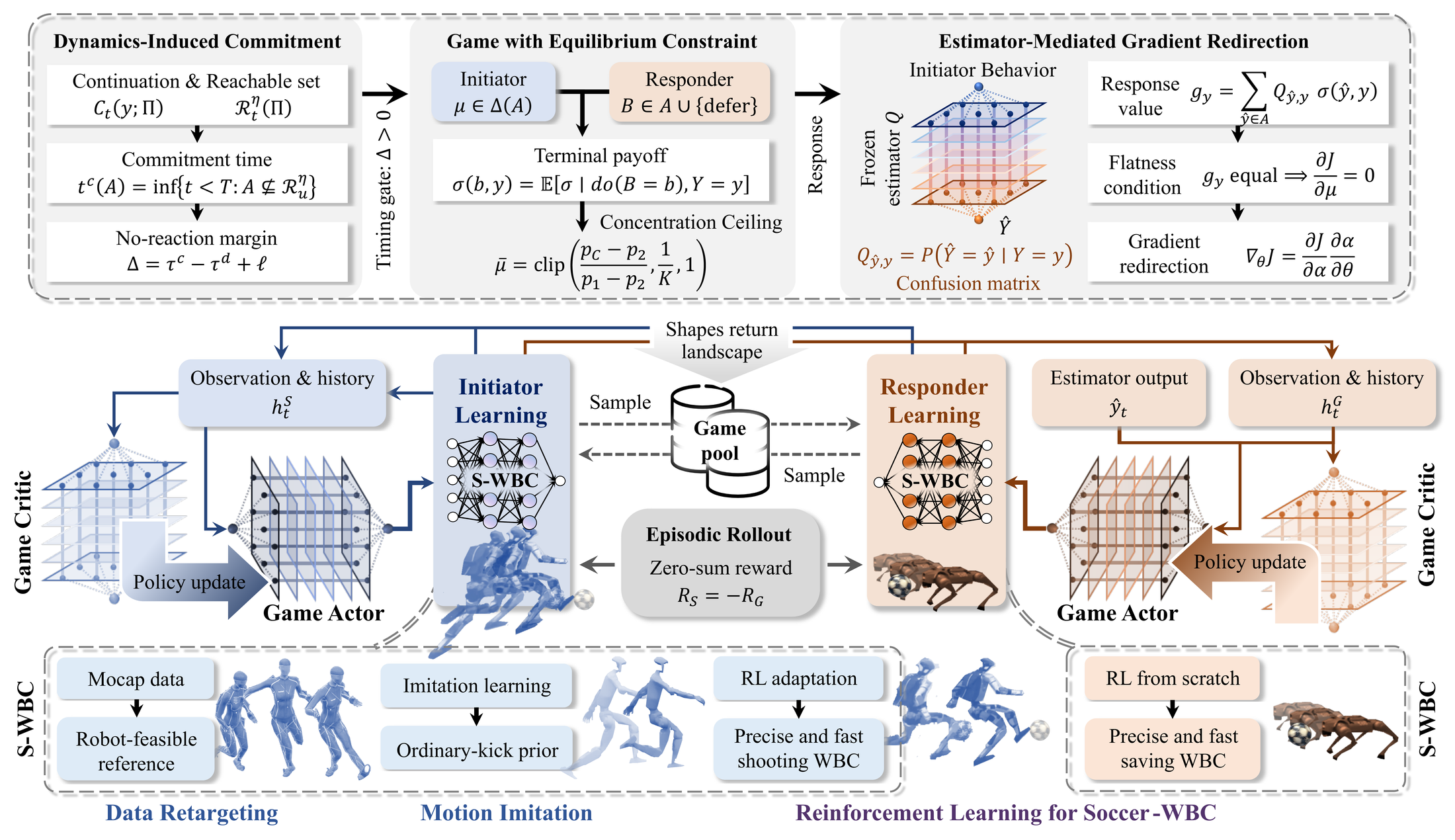
Three-layer architecture
Figure 2: Three-layer architecture separating executable whole-body skills, strategic self-play, and DIC-Map. Fixed S-WBCs realize humanoid shooting and quadruped saving, game-level actor–critics revise strategic commands under zero-sum self-play, and DIC-Map maps the resulting physical rollouts to commitment timing, an equilibrium concentration constraint, and the active first-order learning channel.

Hardware Demonstrations

Scenario 1: Anticipatory save — Go2 reads G1's shot side during kick preparation
Scenario 2: Late feint — G1 revises shot direction right before contact
Scenario 3: Save despite late target revision
Scenario 4: Deferral vs. early-read following

Commitment Instrumentation

Penalty-game instrumentation
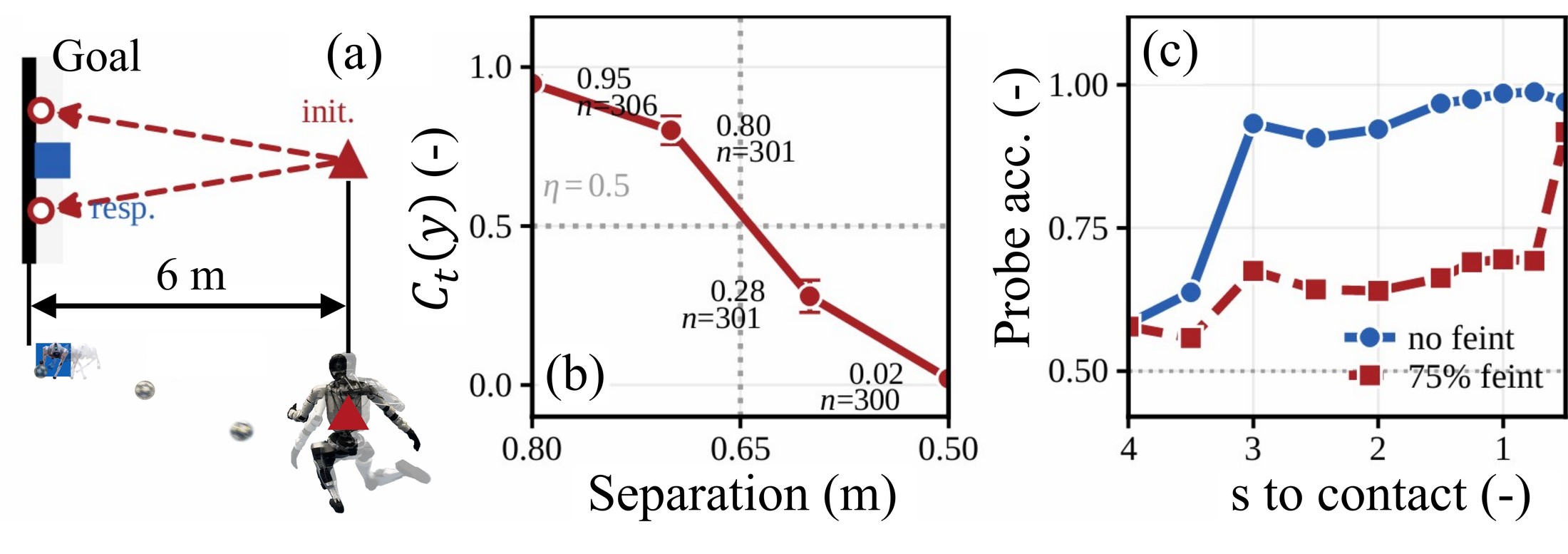
Figure 3: Penalty-game instrumentation showing (a) the terminal aim regions, (b) continuation capability with 95% CIs, where η = 0.5 places the commitment time at 0.64 m or 0.29 s before contact, and (c) outcome readability under nominal and scripted revision.

Sim-to-Real Qualitative Results

Anticipatory goalkeeping on hardware
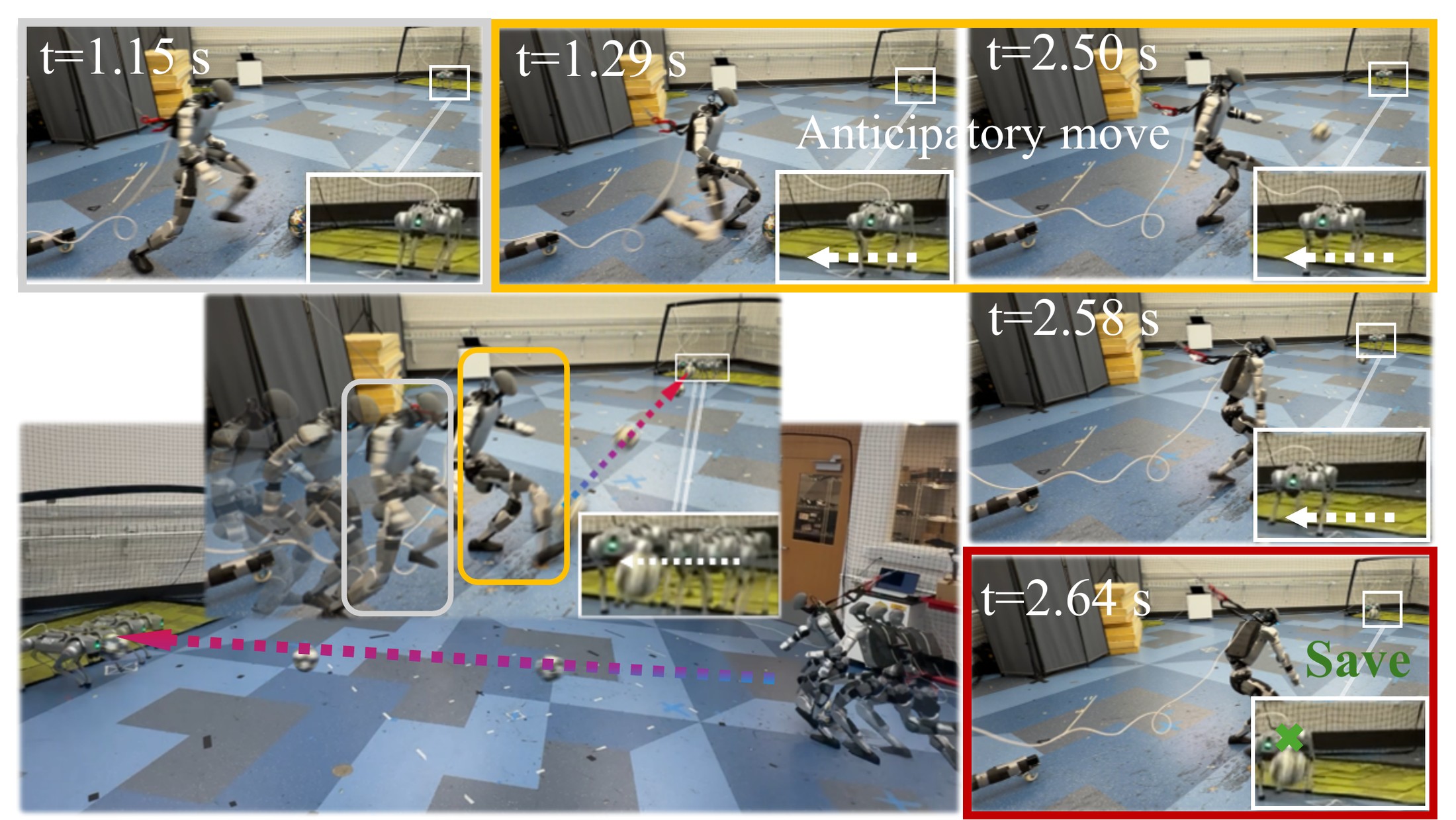
Figure 4: Hardware deployment of anticipatory goalkeeping. Go2 predicts G1's final shot side during kick preparation, initiates an early interception motion, and blocks the ball.
Feint conceded
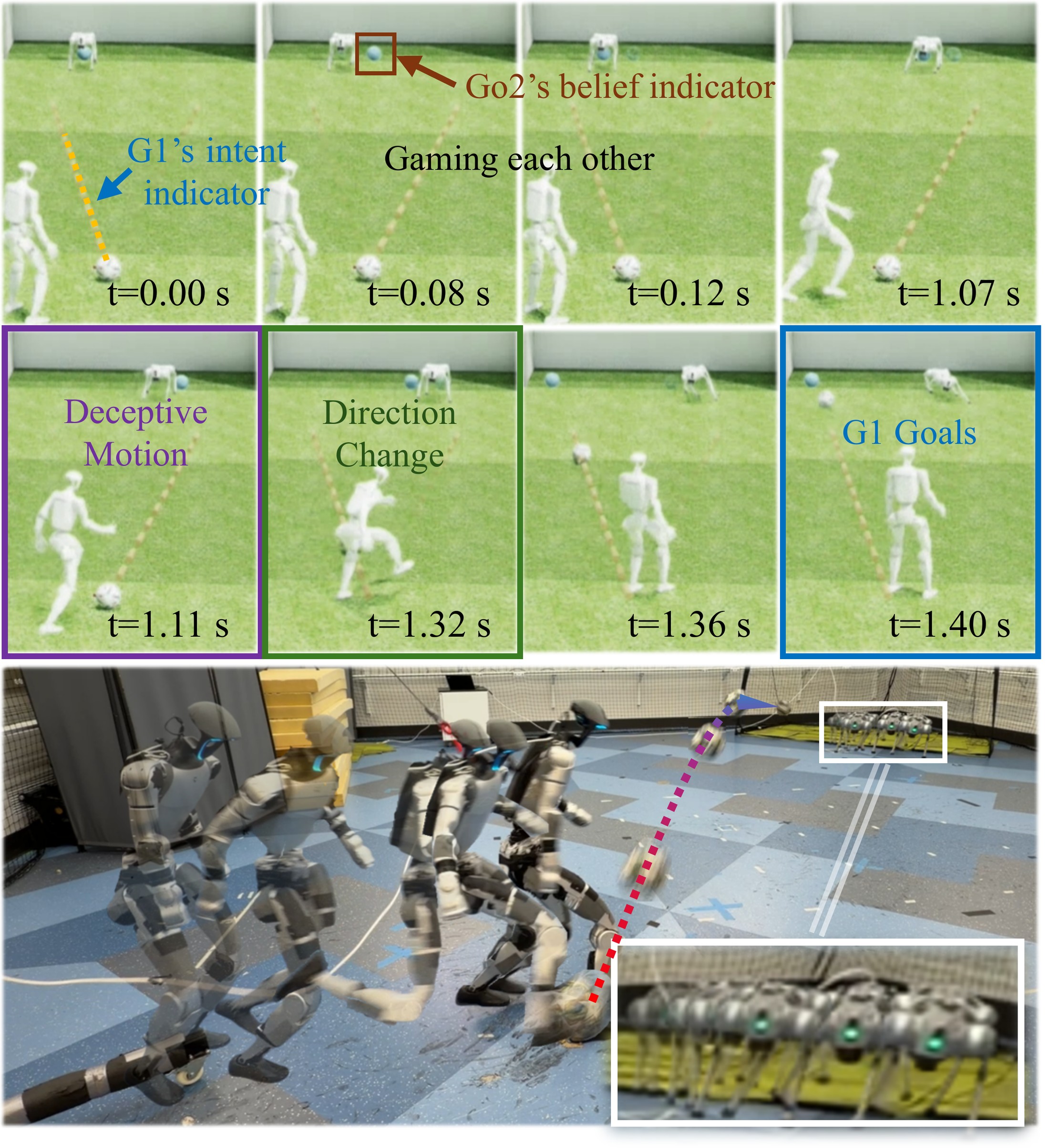
Figure 5: Continuous strategic interaction with a late feint. G1 changes its shot direction immediately before ball contact, causing Go2 to move toward the wrong interception location and concede; the upper sequence shows simulation and the lower sequence the corresponding hardware trial.
Successful anticipatory save
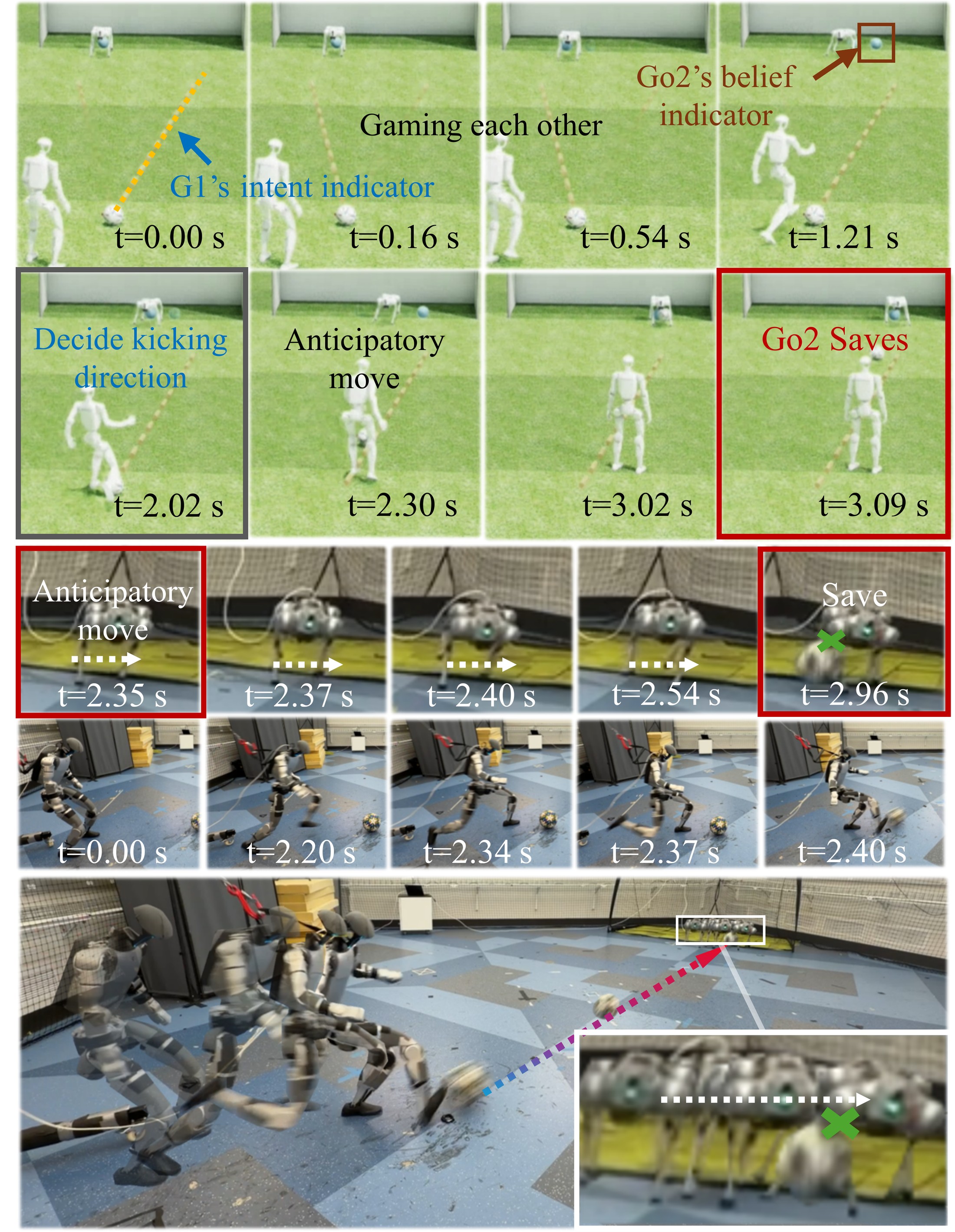
Figure 6: Successful anticipatory goalkeeping during continuous strategic interaction. Go2 predicts G1's final shot direction despite late target revision and saves the ball; the top row shows simulation, the middle row shows separately selected hardware key frames for each robot, and the bottom row shows the hardware overview.

Quantitative Analysis

Responder comparison
Figure 7: Controlled responder comparison at β = 0.8. (a) Read accuracy versus save rate, where A→D and A→F yield similar accuracy gains but save-rate gains of +0.006 and +0.232; (b) cumulative save rate; (c) policy-F class-conditional Qyy, σ(y,y), and gy; (d) terminal responder position versus ball crossing.
Cross-play outcomes
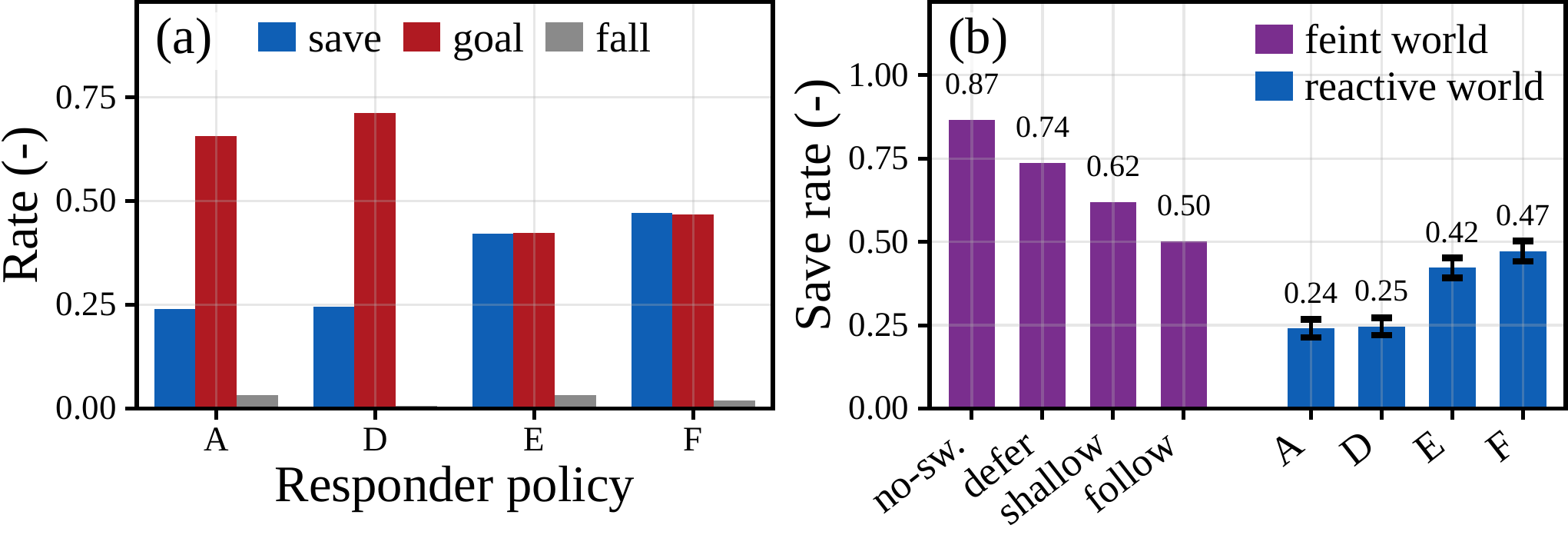
Figure 8: Responder outcomes across evaluation settings. (a) Save, goal, and fall rates for policies A, D, E, and F; (b) a scripted-feint comparison in which deferral attains a save rate of 0.736 versus 0.502 for early-read following, with reactive-world bars reported using 95% CIs.
Posterior equilibrium analysis
Figure 9: Posterior equilibrium analysis. (a) Coverage posteriors, (b) the posterior CDF of r, (c) the concentration-ceiling posterior against observed m, and (d) the posterior CDF of deviation gain. The broader downstream uncertainty reflects limited support for the mismatched-commitment cell.
State recording
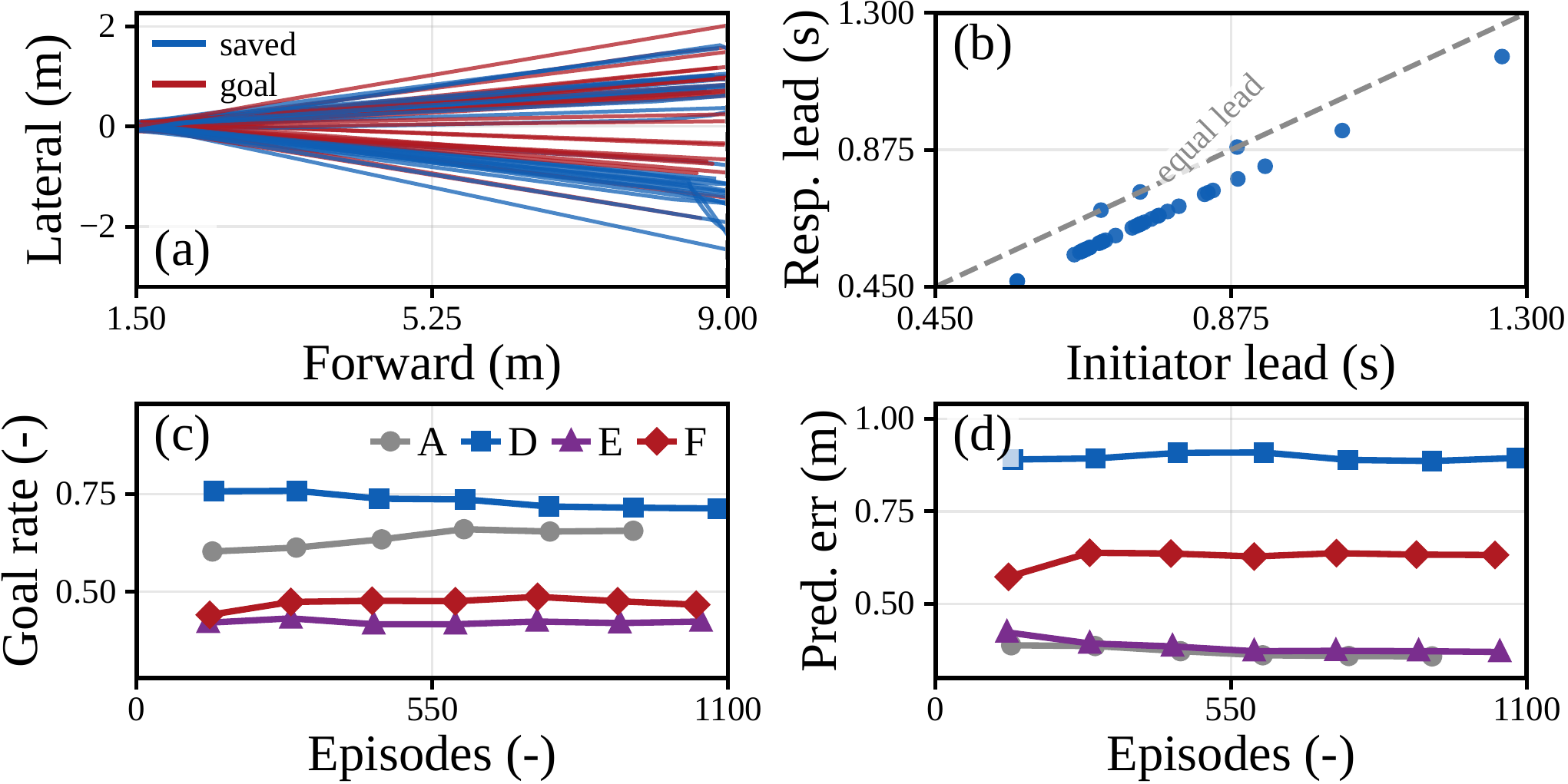
Figure 10: Policy-F state recording. (a) Ball trajectories grouped by terminal event, (b) responder read-lock time against the initiator commitment time, where every sampled episode locks after the ball side is fixed, (c) goal rate, and (d) lateral prediction error.
Phase diagram
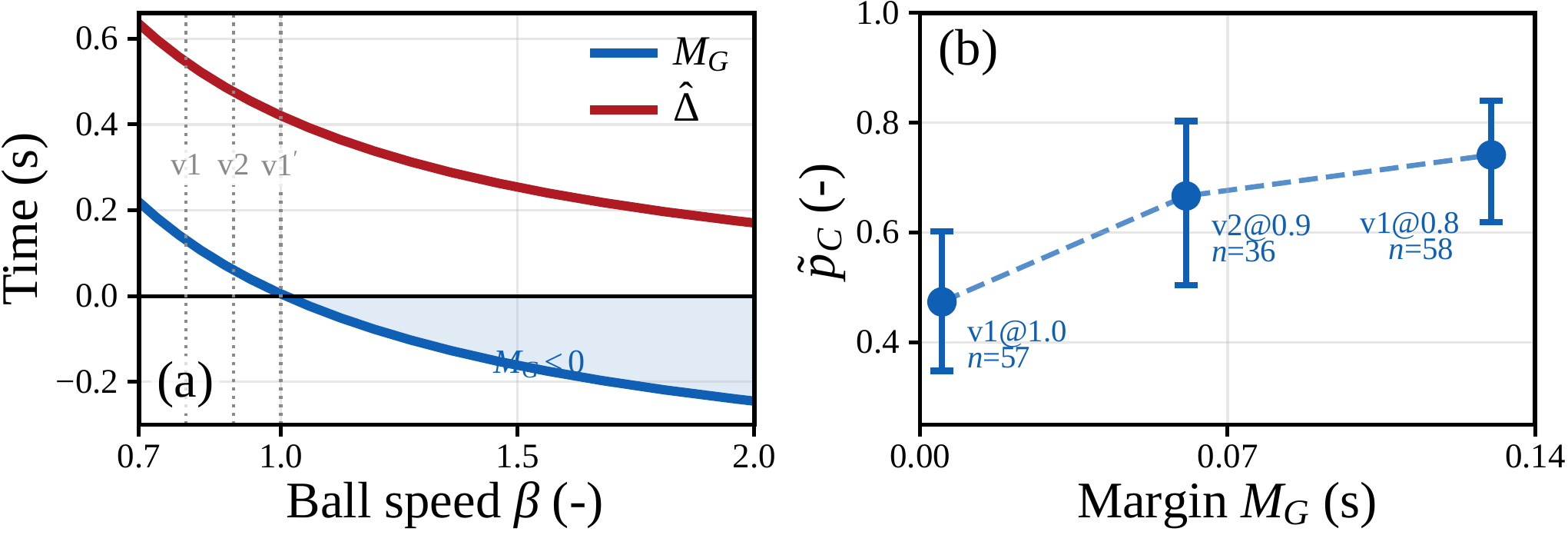
Figure 11: Physical timing across ball speed. (a) The responder spare-time margin and no-reaction margin, and (b) measured deferral coverage versus spare-time margin with 95% Jeffreys intervals and cell counts.
League training dynamics
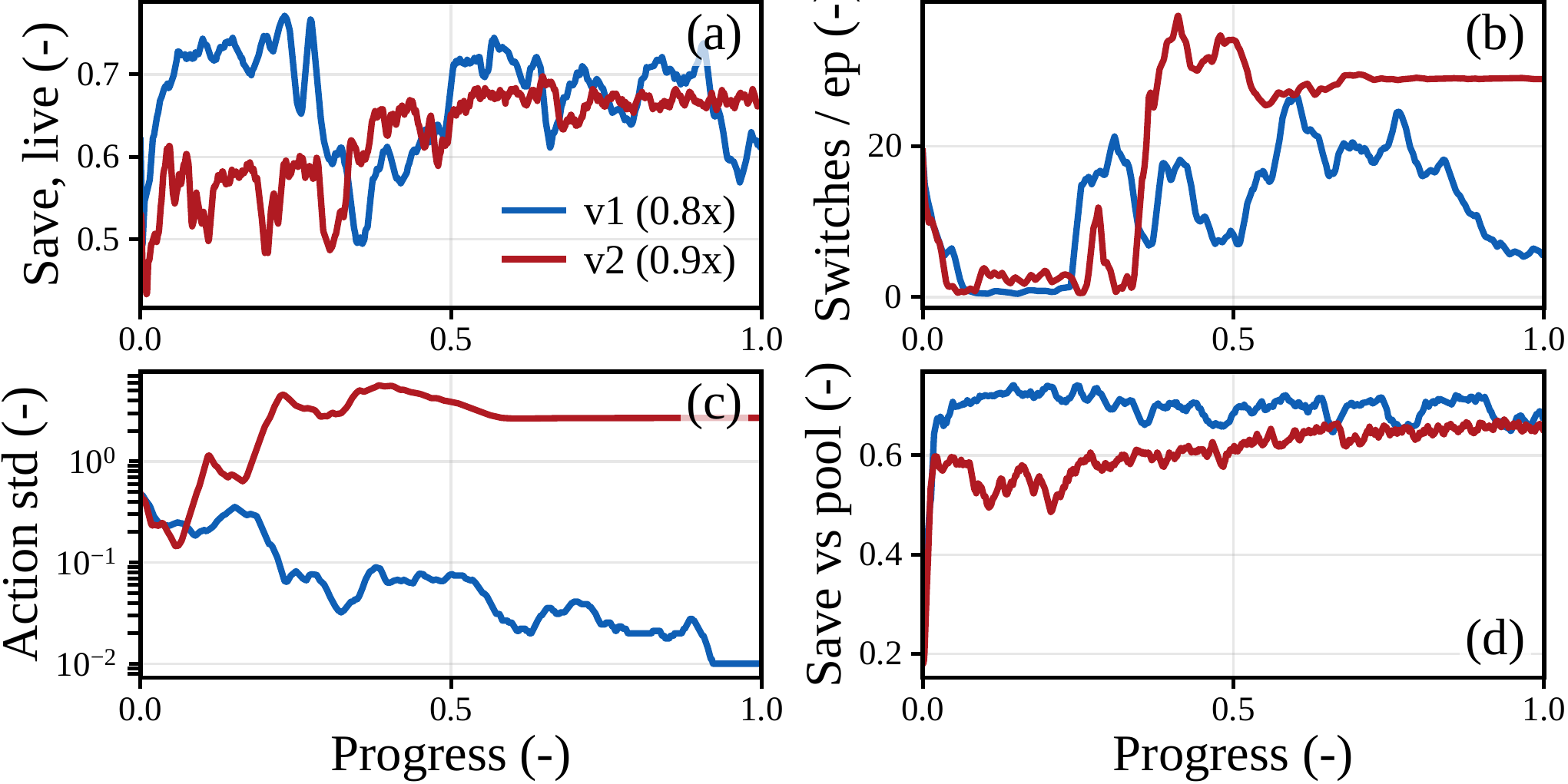
Figure 12: League training dynamics for the two analyzed runs. (a) Live save rate, (b) initiator switches per episode, (c) responder action standard deviation, and (d) save rate against the frozen archive, which increases from 0.51 to 0.68.

BibTeX

@article{geng2026dynamics,
  title={Dynamics-Induced Commitment in Learning-Based Robotic Penalty Kicks},
  author={Geng, Ruize and Zhang, Hao E. and Li, Yisen and Wang, Yikai and Tseng, H. Eric and Zhao, Ding},
  journal={arXiv preprint arXiv:2609.21100},
  year={2026}
}