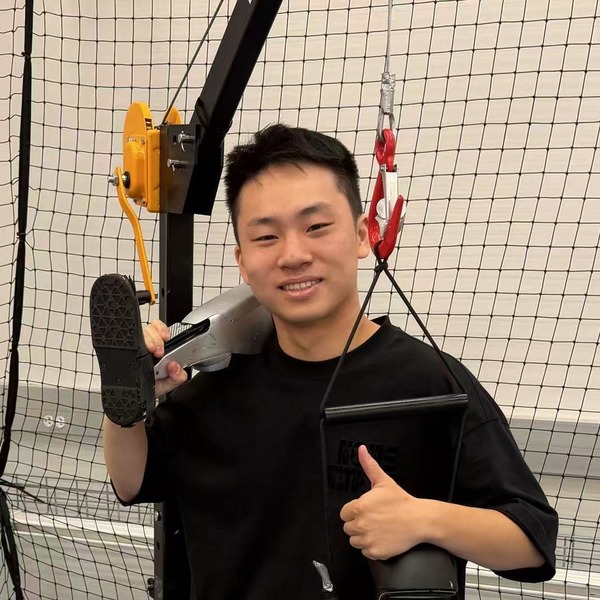
I am a Master’s student in Robotics at Johns Hopkins University. I also worked as a Research Assistant at the Safe AI Lab, Carnegie Mellon University, advised by Associate Professor Ding Zhao and Postdoctoral Researcher Hao E. Zhang. I received my B.S. in Mechanical Design, Manufacturing and Automation from Dalian University of Technology, where I was advised by Prof. Zhenyuan Jia, Academician of the Chinese Academy of Engineering. During my senior year, I spent one year as an exchange student at the NUS (Suzhou) Research Institute, National University of Singapore.
My research focuses on whole-body control of humanoid robots, multi-agent cooperation and game theory, and vision-language models (VLMs). A video of one of my projects has received 110K+ views and 22K+ likes on social media. I have also collaborated with General Motors on a joint research project.
💻 Research Interests
- Whole-body control for humanoid robots: Reinforcement learning, Imitation learning, and Sim-to-real transfer
- Multi-agent cooperation and competition: Self-play and heterogeneous-robot games
- Multi-modal foundation models: Fusing vision, touch, and language for safe robotic manipulation
|
Agile Whole-Body Control |
Multi-Agent Safe Decision Making |
Multi-Agent Self-Play |
Visual-Tactile LM for Safe Manipulation |
🔥 News
- 2026.08: 🎉🎉 Successfully completed a joint research project with General Motors.
- 2026.06: 🎉🎉 I joined the Safe AI Lab at Carnegie Mellon University as a Research Assistant.
📝 Publications
Dynamics-Induced Commitment in Learning-Based Robotic Penalty Kicks
Ruize Geng, Hao E. Zhang, Yisen Li, Yikai Wang, H. Eric Tseng, Ding Zhao
Submitted to IEEE TNNLS (Full version) and ICRA (Conf version)
- We introduce dynamics-induced commitment mapping (DIC-Map), a body-grounded framework that identifies when physical dynamics eliminate strategic alternatives in robotic games, revealing how embodiment fundamentally shapes learning and decision making in humanoid-quadruped penalty kicks.
SAGE: Safety-Aligned Gradient Enforcement for Human-Robot Collaboration
Yisen Li*, Hao Zhang*, Ruize Geng, Yves Tseng, Ding Zhao, H. Eric Tseng (* equal contribution)
Submitted to IEEE T-RO (Full version) and ICRA (Conf version)
- We propose safety-aligned gradient enforcement (SAGE), which aligns interpretable multi-agent policy learning with safety-constrained execution through differentiable safety internalization and Lyapunov-regulated team-aware policy updates, enabling safe physical collaboration between multiple humanoid robots and humans.
Anticipatory Robot Goalkeeping via Monotone Optimal Stopping
Hao E. Zhang*, Ruize Geng*, Yisen Li, Yaru Niu, Yikai Wang, Raihan Haque, Khalil Zbiss, Guanyang Luo, Hui-ping Wang, H. Eric Tseng, Ding Zhao (* equal contribution)
Submitted to IEEE TCST (Full version) and ICRA (Conf version)
- We formulate anticipatory robotic interception as a finite-horizon optimal stopping problem and propose monotone optimal stopping (MOS), allowing a quadruped goalkeeper to decide when to act before shot intent is fully resolved while retaining closed-loop adaptation to deceptive direction changes.
Banana Kick: Response-Informed Skill Evolution for Humanoid Soccer
Hao E. Zhang*, Ruize Geng*, Raihan Haque, Khalil Zbiss, Guanyang Luo, Hui-ping Wang, H. Eric Tseng, Ding Zhao (* equal contribution)
Submitted to IEEE T-RO (Full version) and ICRA (Conf version)
- We propose response-informed skill evolution (RISE), a closed-loop objective-continuation method for policy adaptation. RISE evolves the ordinary kick into a high-spin curved kick with 11.55 rad/s mean ball spin.
Cognition to Control: Multi-Agent Learning for Human-Humanoid Collaborative Transport
Hao Zhang, Yisen Li, Ruize Geng, Yves Tseng, Yaru Niu, Ding Zhao, H. Eric Tseng
Submitted to IEEE TCST (Full version) and ICRA (Conf version)
- In multi-agent human-robot collaboration, long-horizon coordination decisions and physical execution must co-evolve under contact, feasibility, and safety constraints. We address this limitation with cognition-to-control (C2C), a three-layer hierarchy that makes the deliberation-to-control pathway explicit.
📖 Educations
- 2025.08 - now, M.S. in Robotics, Johns Hopkins University, Baltimore, USA.
- 2024.09 - 2025.07, Exchange Student, NUS (Suzhou) Research Institute, National University of Singapore, Suzhou, China.
- 2021.09 - 2025.07, B.E. in Mechanical Design, Manufacturing and Automation, Dalian University of Technology, Dalian, China.
💻 Research Experience
- 2026.06 - now, Research Assistant, Safe AI Lab, Carnegie Mellon University, Pittsburgh, USA.
- 2023.07 - 2023.08, Research Intern, Institute of Automation, Chinese Academy of Sciences, Beijing, China.