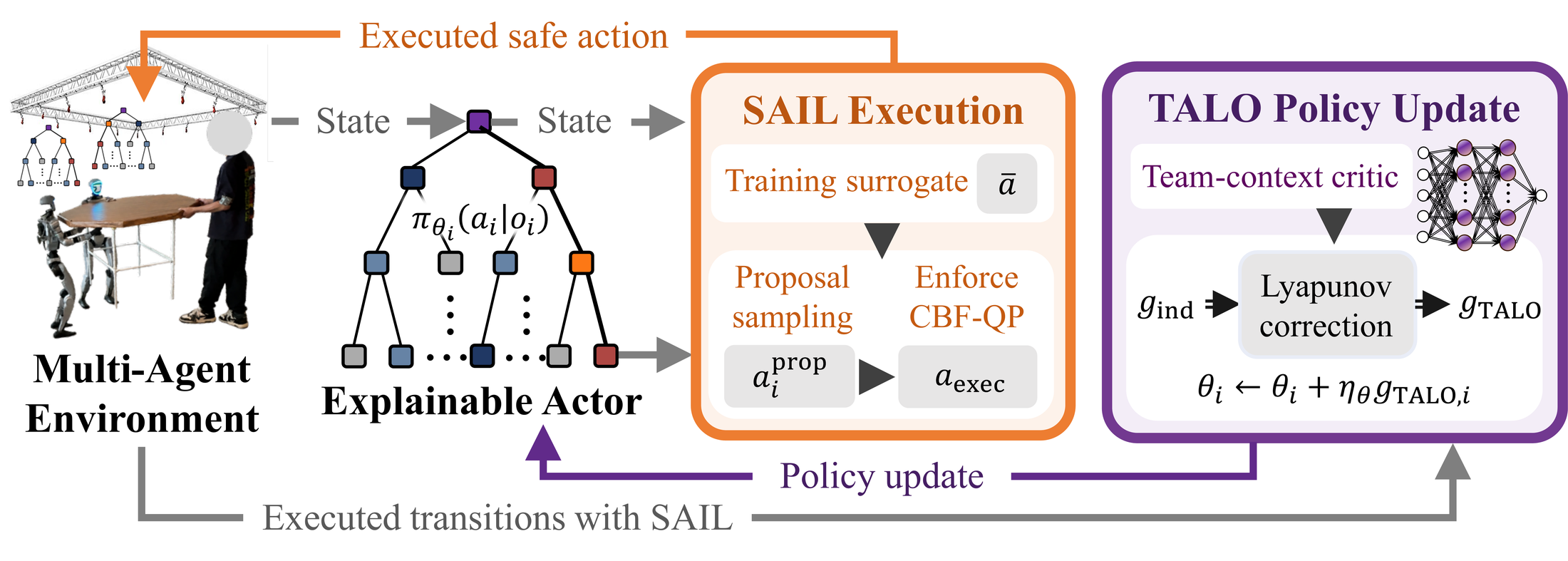
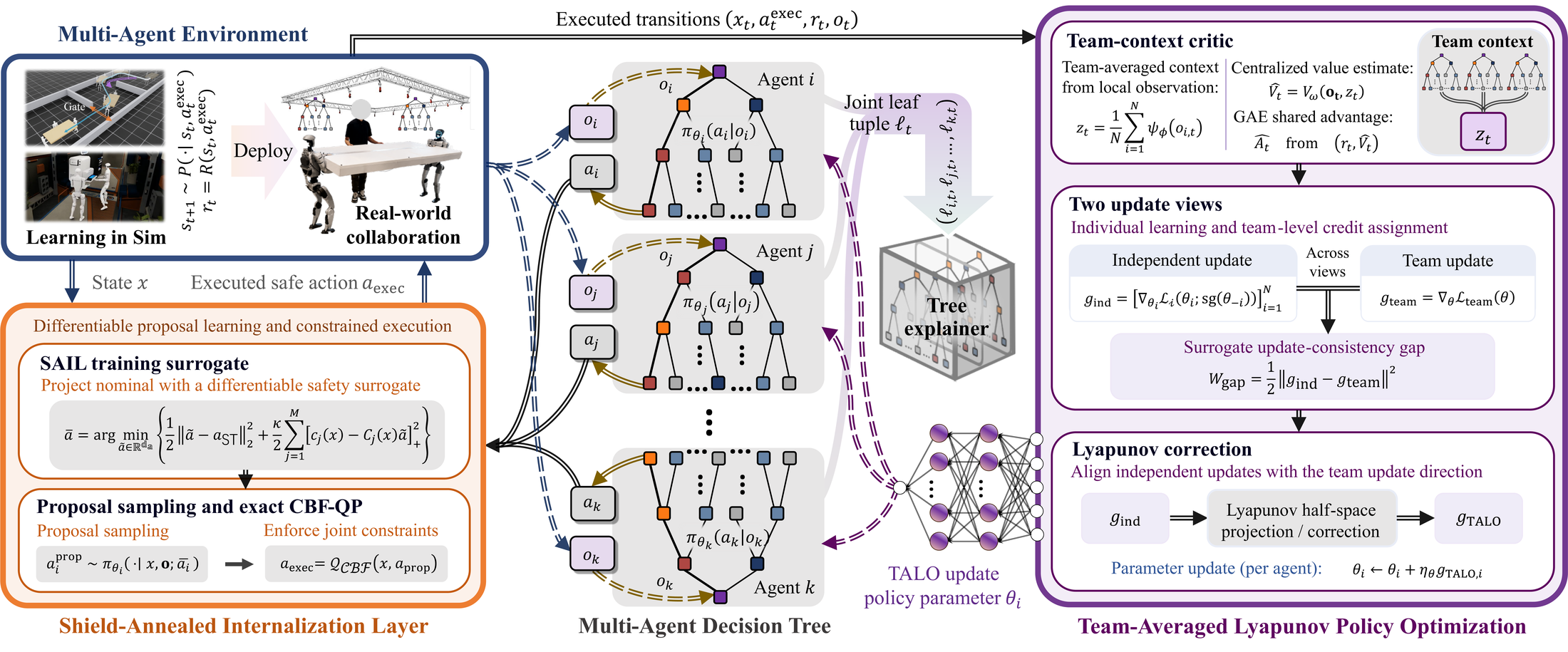
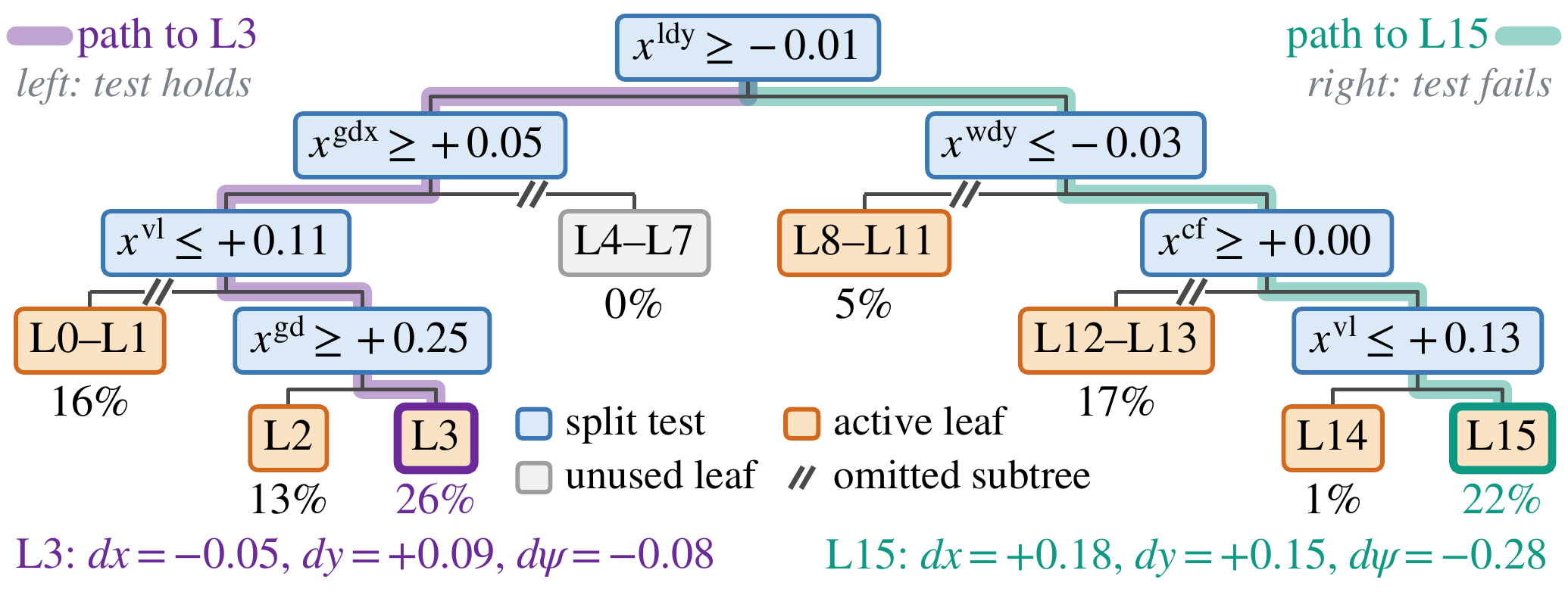
Figure 1: Architecture of SAGE integrating auditable hard-tree nominal policies, SAIL-based proposal learning, exact joint CBF-QP execution, and TALO-based multi-actor policy optimization.
Submitted to IEEE T-RO (Full version) and ICRA (Conf version)
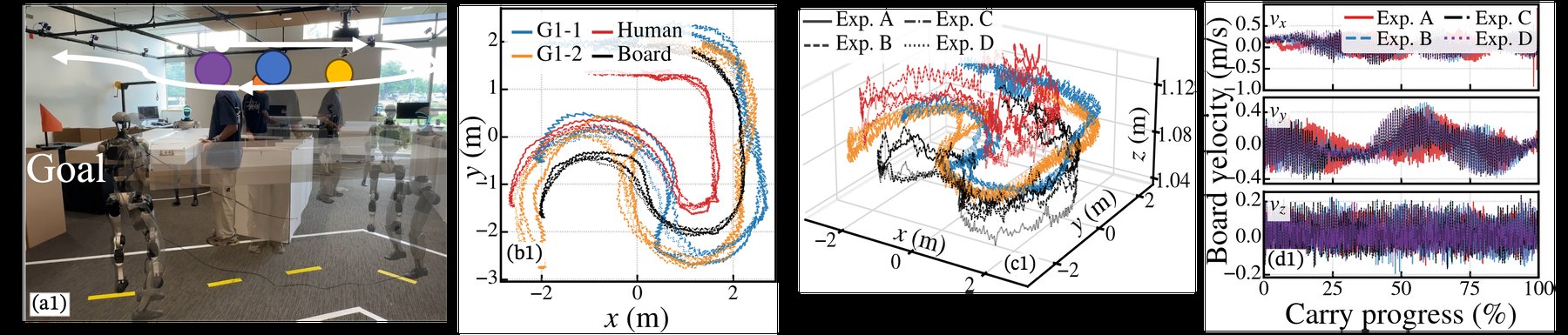
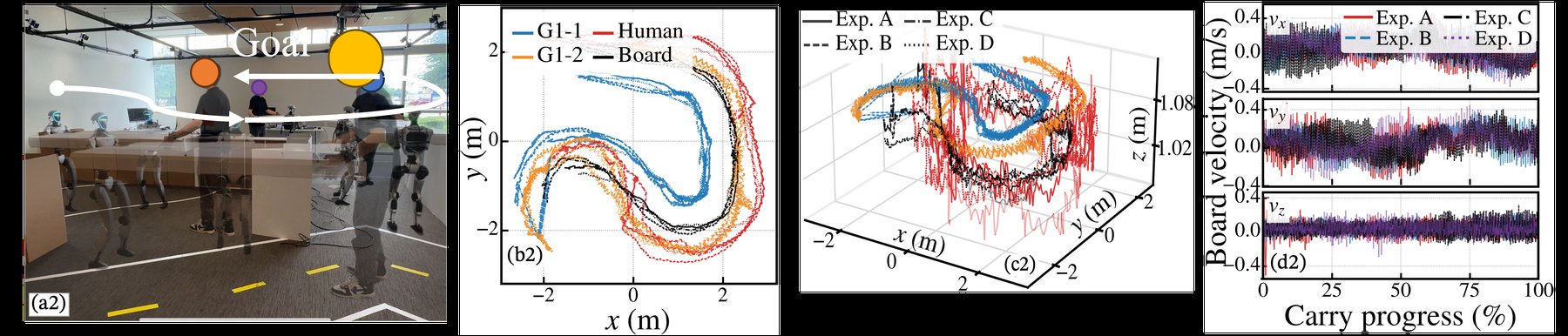
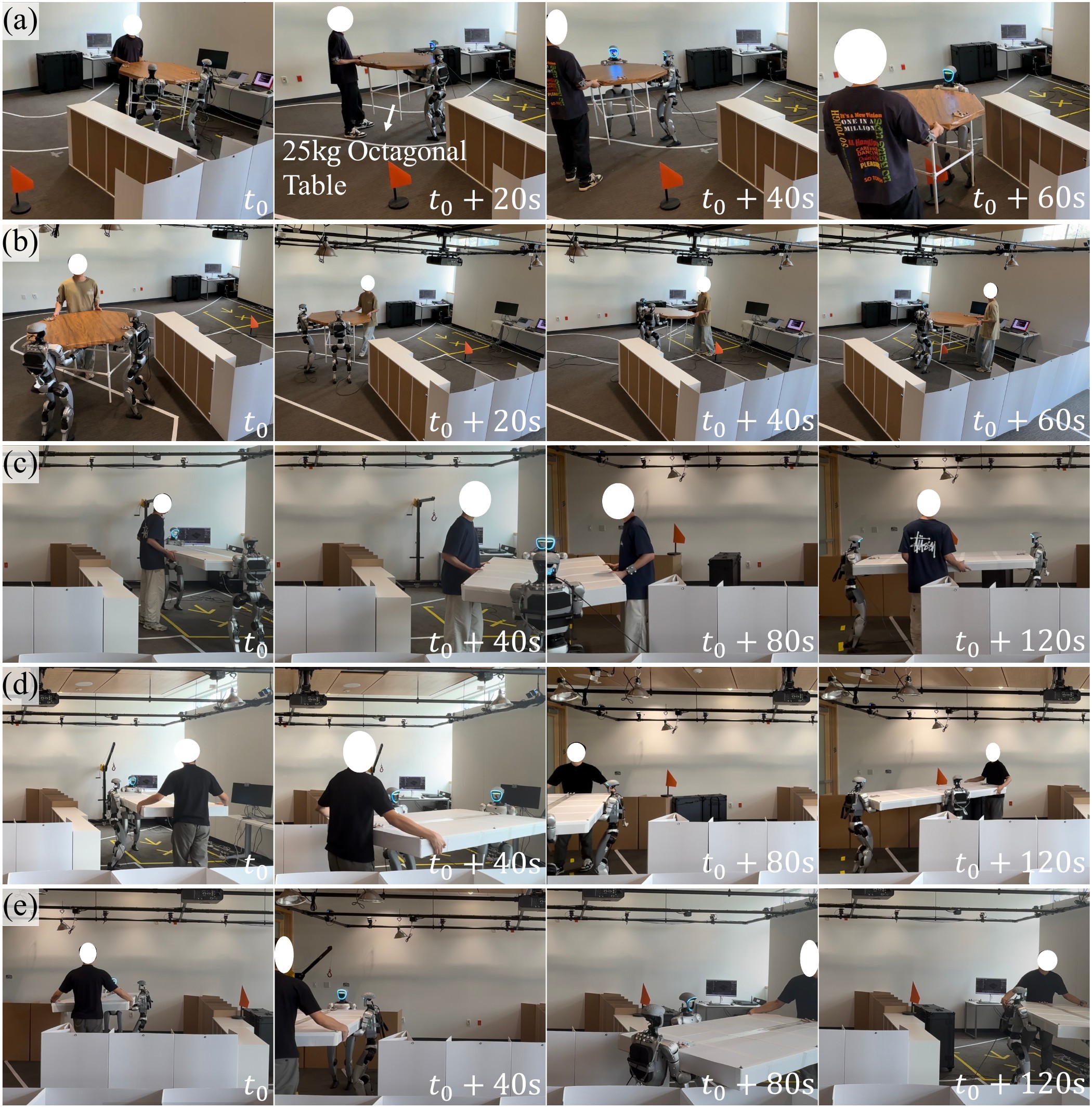
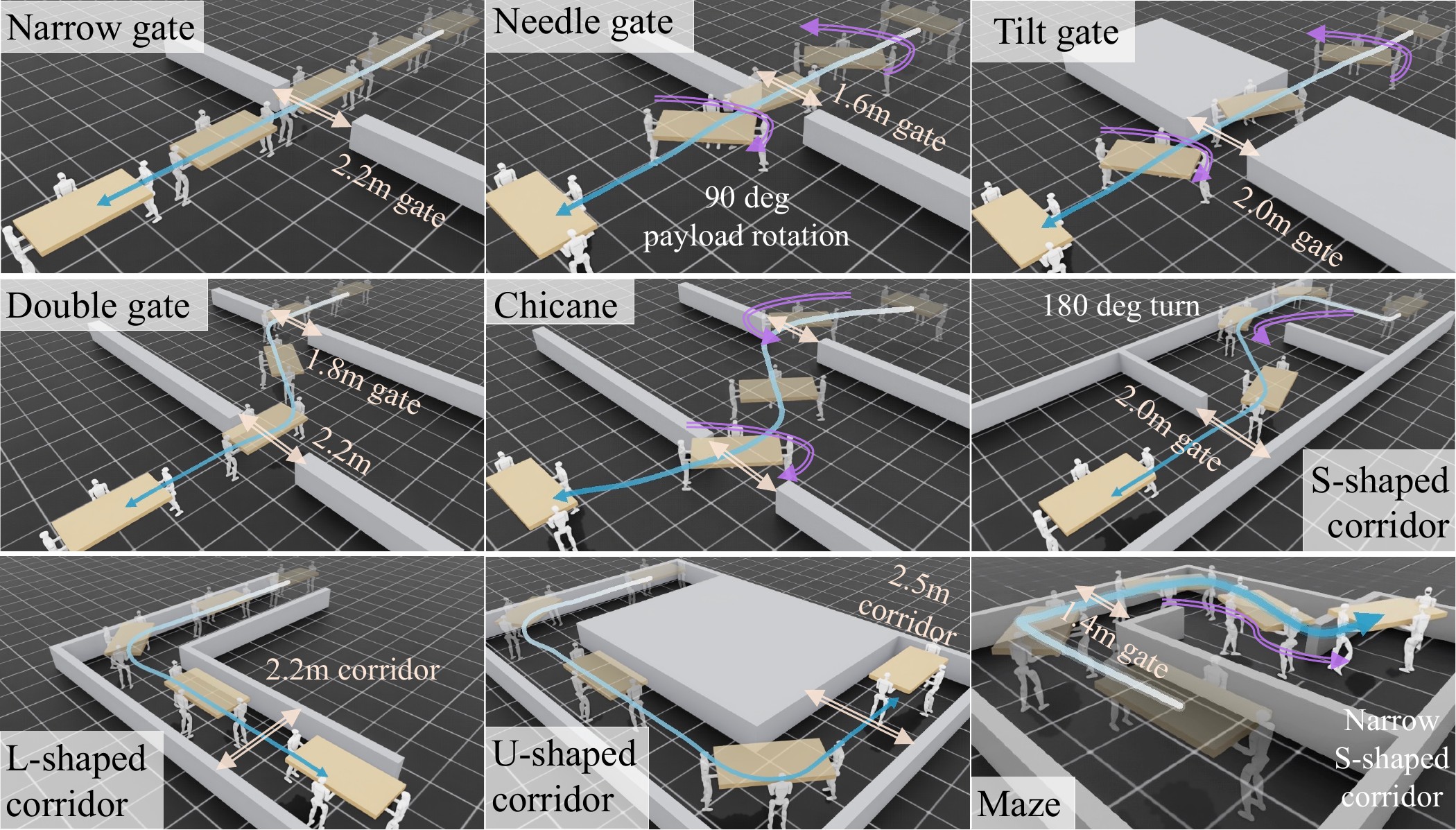
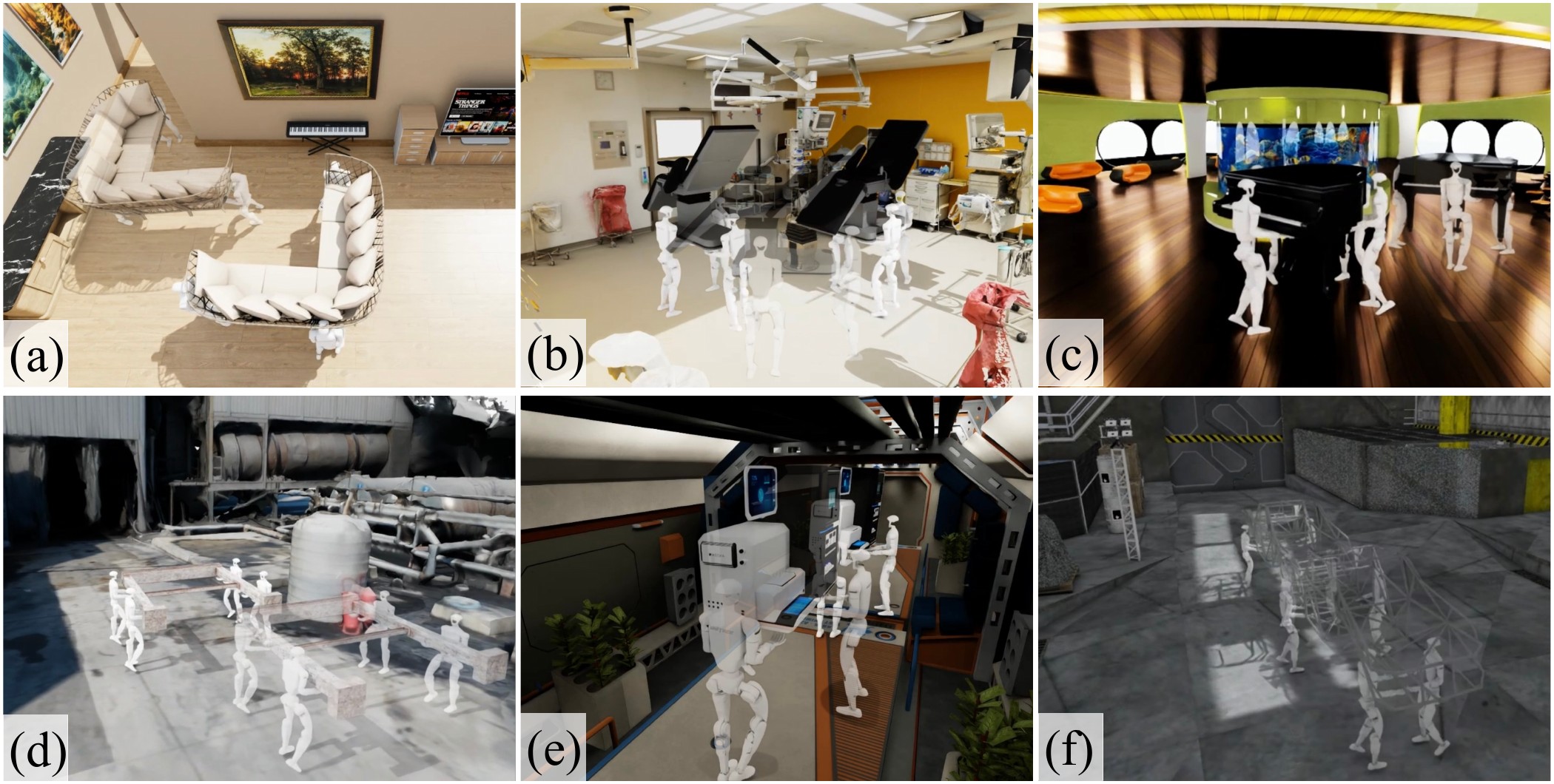
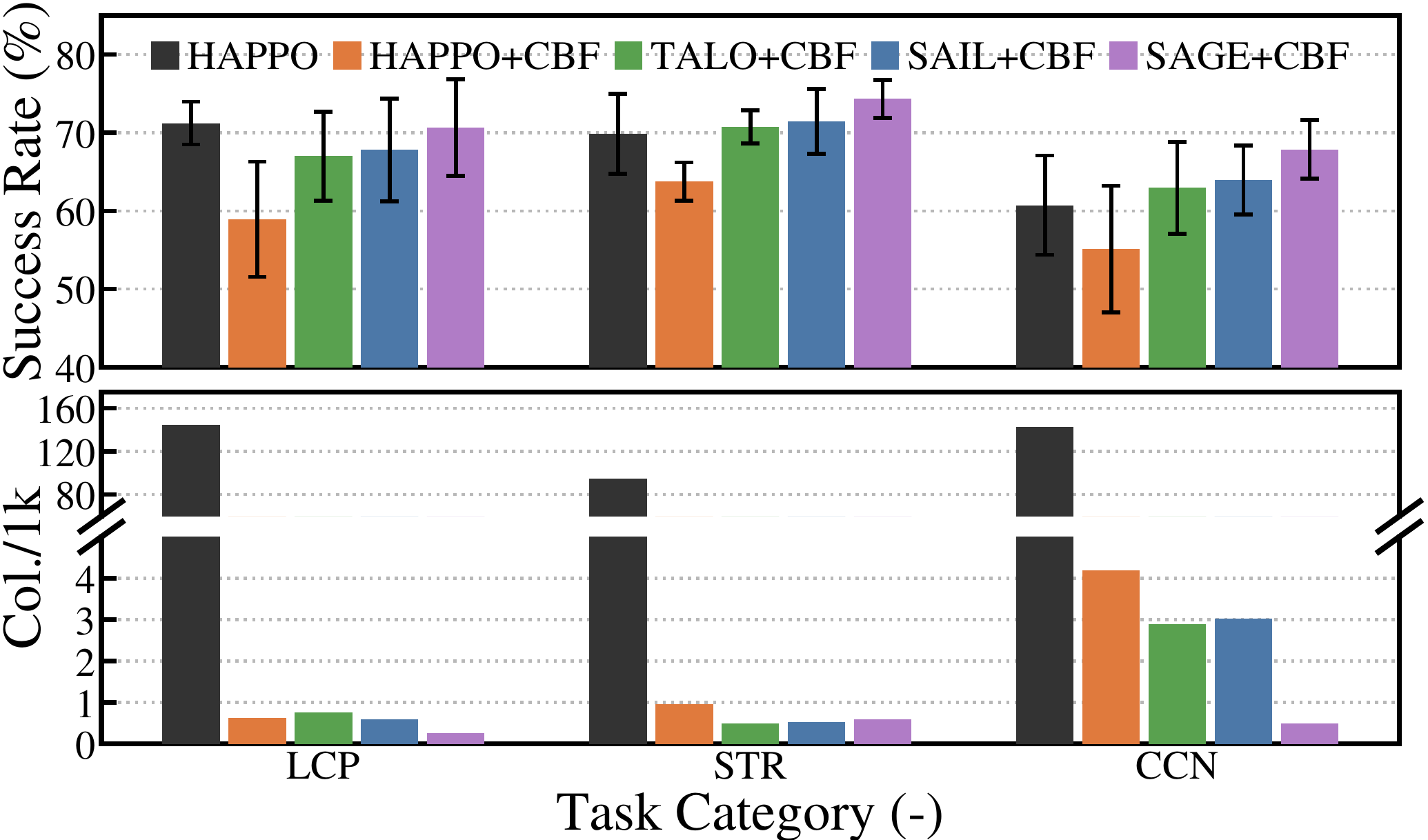
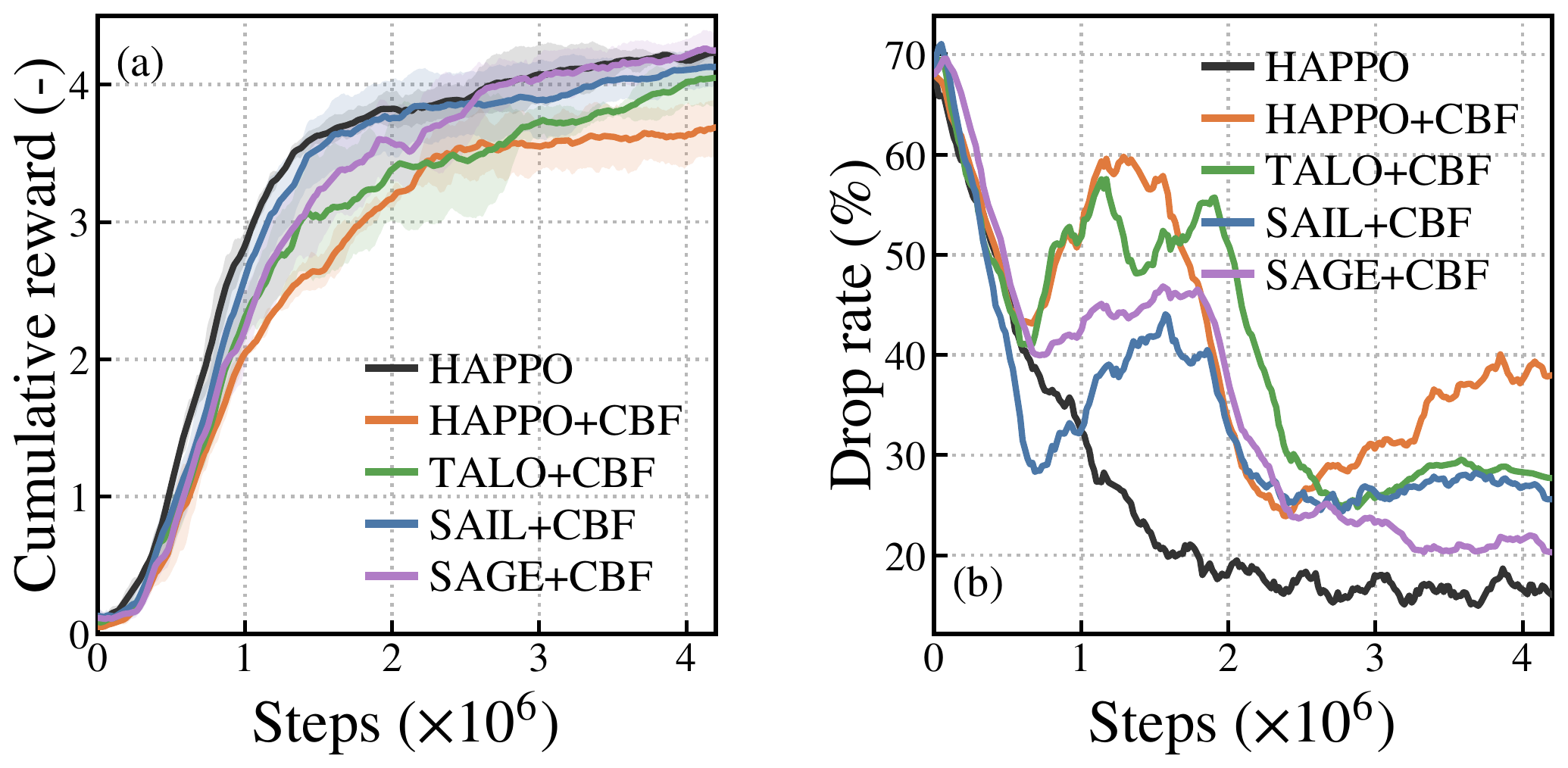
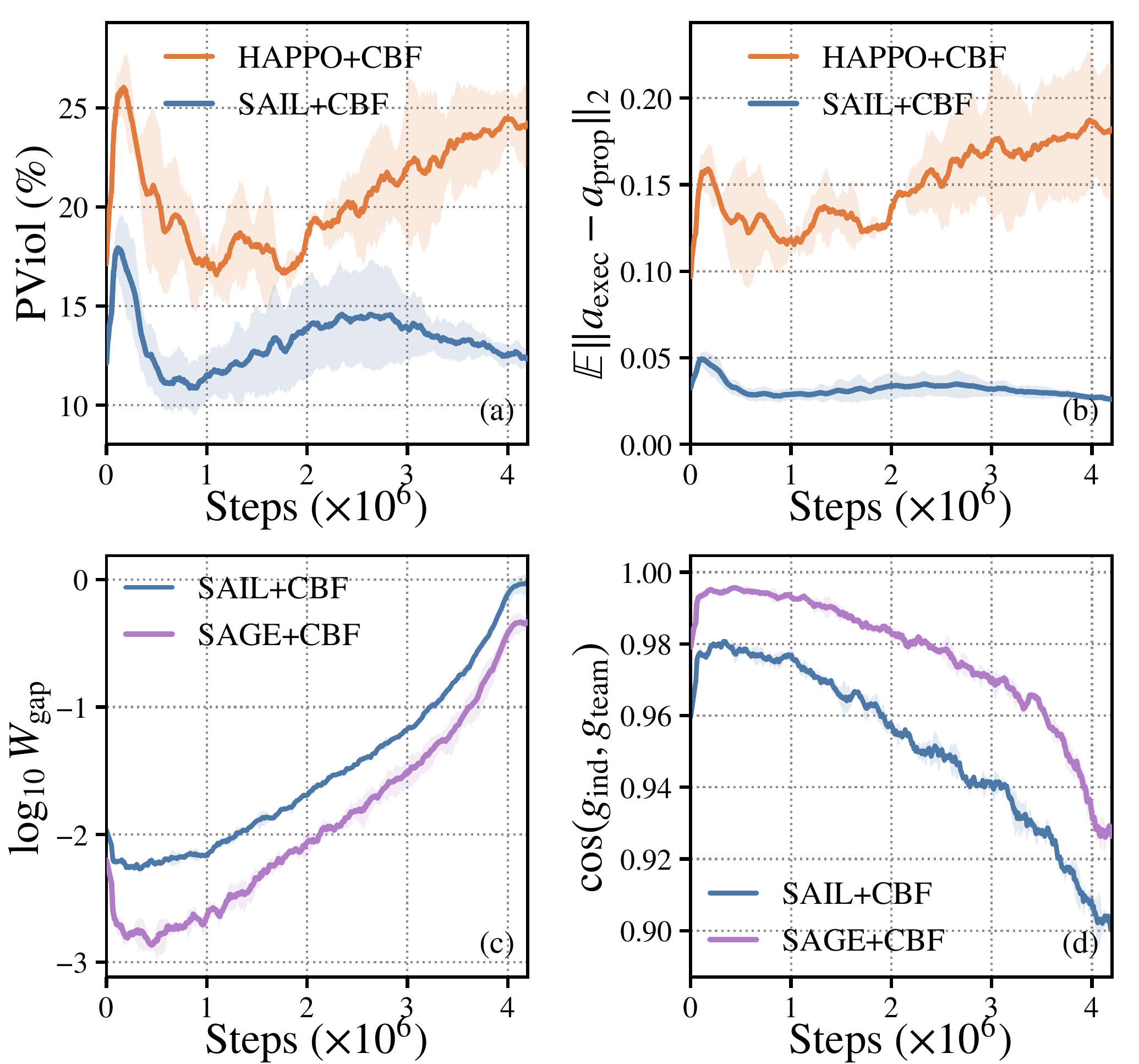
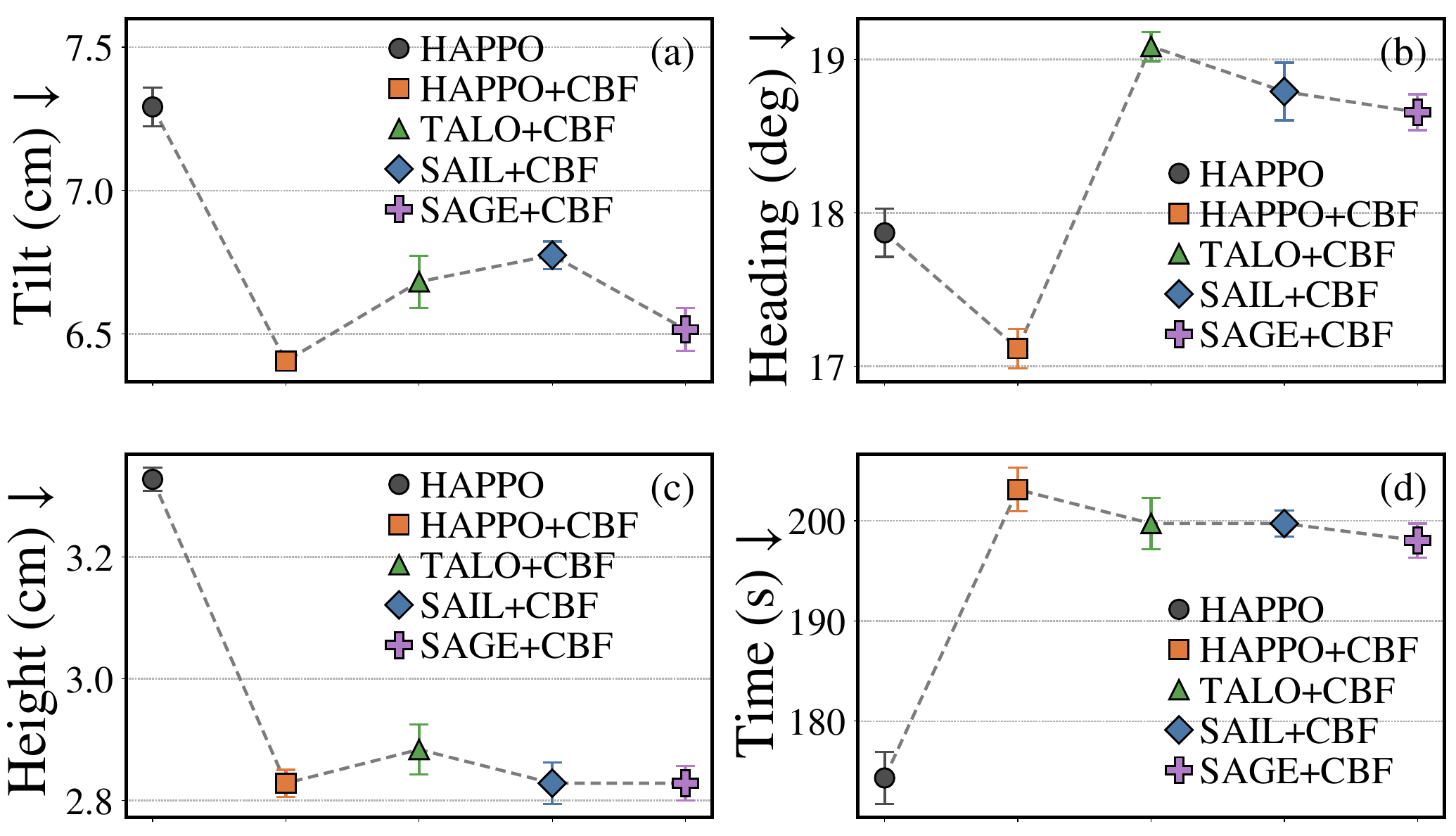
Multi-party human–robot collaboration poses a dual challenge: robot decisions should remain interpretable and auditable, while executed actions must satisfy safety constraints during physical interaction. Combining explainable decision-tree policies with control-barrier-function (CBF) filtering provides a promising architecture but creates two learning mismatches in multi-agent reinforcement learning. Safety projection changes the action applied to the environment, while the coupled proposal graph can misalign independently optimized actor updates with a team-level update. We present safety-aligned gradient enforcement (SAGE) to address both mismatches. Its shield-annealed internalization layer (SAIL) uses a differentiable finite-penalty proposal map while retaining the exact CBF quadratic program for execution, preserving constraint-normal sensitivity to internalize repeatedly active safety constraints. Team-averaged Lyapunov policy optimization (TALO) constructs a team-aware update reference and applies a Lyapunov half-space correction to regulate independent actor updates. Physical experiments with two humanoid robots and a human partner demonstrate deployment feasibility. Across nine simulation scenarios, SAGE achieves a 71.0% success rate with 0.5 collision steps per thousand environment steps. Ablations show that direct CBF filtering reduces collision frequency by 98.5% but decreases success from 67.3% to 59.3%. SAIL reduces proposal violation by 48.8% and proposal–execution correction by 85.2%, while TALO reduces the update-consistency gap by 50.8%.
@article{li2026sage,
  title={SAGE: Safety-Aligned Gradient Enforcement for Human-Robot Collaboration},
  author={Li, Yisen and Zhang, Hao and Geng, Ruize and Tseng, Yves and Zhao, Ding and Tseng, H. Eric},
  journal={arXiv preprint arXiv:2609.21130},
  year={2026}
}